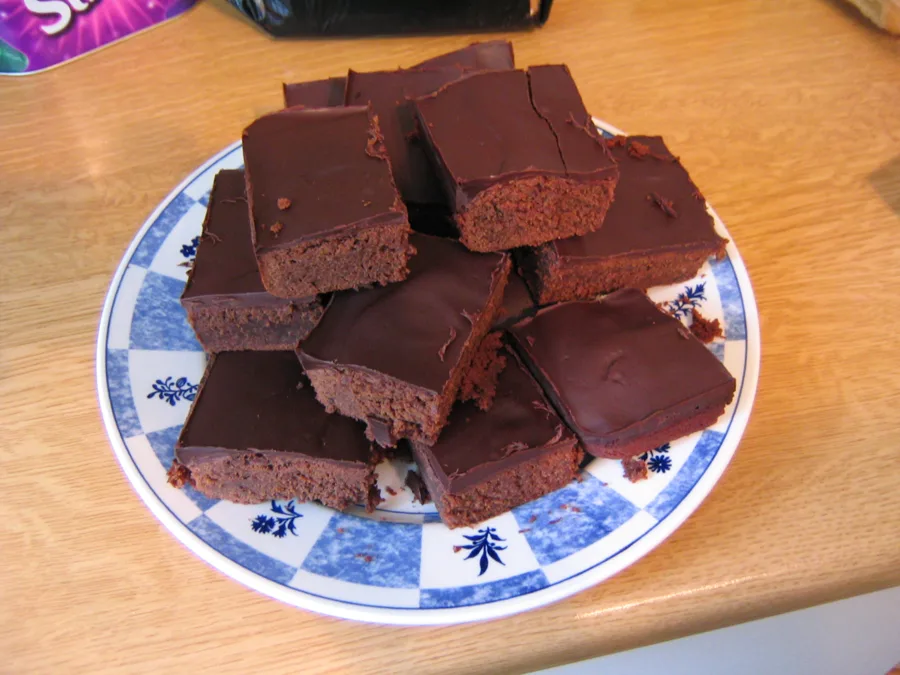
Brownies divide the world into fudgy and cakey, and this recipe is unapologetically for the fudgy camp: dense, dark, almost truffle-like in the centre, with a thin crackly crust on top. The texture comes from ratios, not tricks — more butter and sugar than flour, eggs whipped with the sugar, and chocolate in two forms.
That crackly top, by the way, is a sugar crust, and it forms when the sugar is properly dissolved into the warm butter and beaten with the eggs until the mixture turns pale and glossy. Skip the beating and the brownies still taste good, but the top will be matte. Two minutes with a whisk is the entire price of the shine.
The pull time decides fudgy versus dry more than any ingredient. The skewer should come out with moist crumbs and a smear of batter — never clean. Brownies continue setting as they cool, and an extra three minutes in the oven is the difference between fudge and cake. When in doubt, pull them early.
Why this recipe works
Fudginess is a ratio: high fat and sugar, low flour, and just enough egg to set. The crackly top is a thin meringue — sugar dissolved into the beaten eggs forms a delicate film that dries and fractures in the oven. Pulling the brownies while the centre still smears on the skewer works because the residual heat sets that centre into fudge as the pan cools; fully baked in the oven means dry at the table.
Ingredients
- 3/4 cup (170 g) butter
- 6 oz (170 g) dark chocolate (60–70%), roughly chopped
- 1 cup (200 g) white sugar
- 1/2 cup (100 g) brown sugar, packed
- 3 large eggs, at room temperature
- 2 tsp vanilla extract
- 3/4 cup (95 g) all-purpose flour
- 1/3 cup (30 g) cocoa powder
- 1/2 tsp fine sea salt
- 1/2 cup (85 g) chocolate chips (optional)
Quantities are given in cups and grams. Nutrition (≈ 230 kcal and 3g protein per serving) is an estimate calculated from these ingredients.
Method
- Heat the oven to 350°F (175°C). Line an 8x8-inch (20x20 cm) pan with baking paper, leaving an overhang to lift the brownies out.
- Melt the butter and chopped chocolate together (microwave in 30-second bursts, or a bowl over simmering water) until smooth. Leave to cool for 5 minutes — it should be warm, not hot.
- In a large bowl, whisk both sugars with the eggs vigorously for 2 full minutes, until the mixture is pale, thick and glossy. Whisk in the vanilla.
- Pour the warm chocolate mixture into the eggs and whisk until combined and shiny.
- Fold in the flour, cocoa and salt with a spatula until just combined, then fold in the chocolate chips if using. The batter will be thick and glossy.
- Spread into the pan and bake 23–27 minutes, until the top is crackled and set at the edges and a skewer in the centre comes out with moist crumbs and a little batter smear — not clean, not dripping.
- Cool completely in the pan (at least 1 hour) before lifting out and slicing with a hot, dry knife. The centre sets into fudge as it cools.
Tips for success
- **Beat the eggs and sugar properly.** Two minutes of whisking dissolves the sugar and builds the crackly top — it is the whole secret of the shiny crust.
- **Underbake on purpose.** A clean skewer means cakey brownies. Moist crumbs and a smear is the pull point.
- **Cool before cutting.** Hot brownies smear and collapse; fully cooled ones slice into clean, dense squares. A hot knife wiped between cuts keeps the edges sharp.
- **Salt is not optional** — it is what makes the chocolate taste like chocolate instead of just sweet.
Serving and variations
Serve warm with vanilla ice cream and a pinch of flaky salt, or cold and straight from the tin. Add-ins that respect the fudge: walnuts, a swirl of peanut butter, espresso powder (1 tsp, deepens the chocolate), or a handful of raspberries pressed into the top before baking.
Storage
Keep in an airtight container up to 5 days (they get fudgier on day two). Freeze up to 3 months, wrapped; thaw at room temperature.
Frequently asked questions
What makes brownies fudgy instead of cakey?
Ratio and mixing. Fudgy brownies have a high fat-to-flour ratio (here, lots of butter and chocolate, little flour), melted butter rather than creamed, and minimal mixing once the flour goes in. Cakey brownies come from more flour, more egg aeration and a longer bake.
How do you get the crackly top on brownies?
Dissolve the sugar properly: whisk the sugars with the eggs for a full 2 minutes until pale and glossy, then add warm (not hot) melted chocolate. That creates a thin meringue-like layer that bakes into the signature crackle.
How do I know when brownies are done?
The edges should look set and the centre just barely so, with the top crackled. A skewer in the centre should come out with moist crumbs and a slight smear of batter. If it comes out clean, they have gone past fudgy — serve them warm with ice cream and pull the next batch earlier.
Can I make brownies with cocoa powder only?
Yes — replace the chopped chocolate with an extra 1/4 cup (25 g) of cocoa and an extra 2 tbsp of butter. The flavour will be slightly less deep and the texture a touch less dense, but they are still properly fudgy.
Why did my brownies turn out dry?
Almost always overbaking — even 3–4 extra minutes matters in an 8-inch pan. Other causes: too much flour (weigh it if you can) or an oven running hot. An oven thermometer is the cheapest fix in baking.