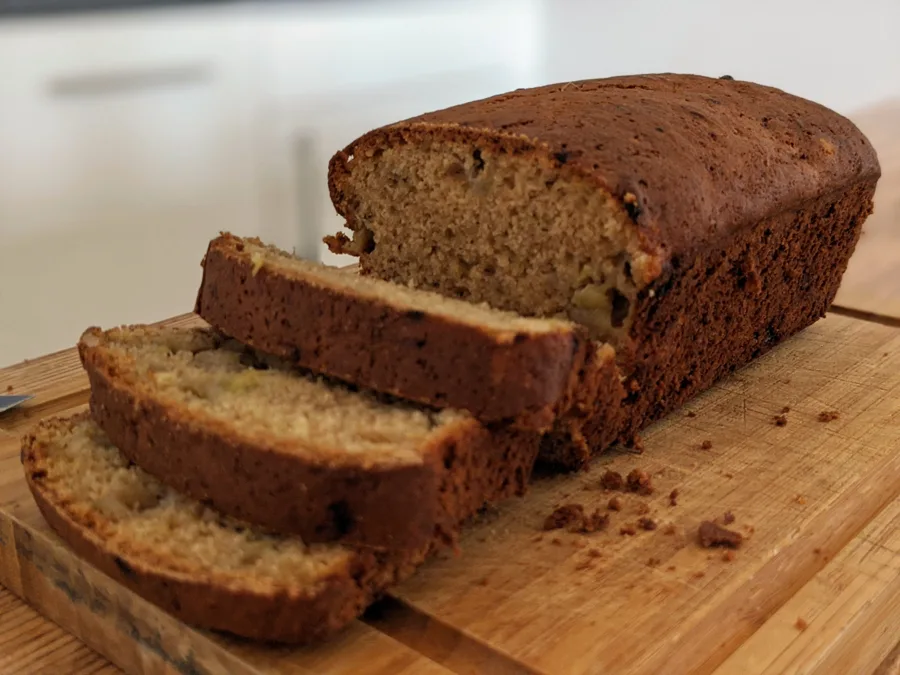
Banana bread lives or dies on the bananas. They should be past eating — skins heavily speckled or fully brown, flesh soft and intensely sweet. Yellow bananas make a pale, bland loaf no recipe can rescue; nearly-black bananas make the deep, caramel-flavoured bread everyone is actually looking for. Freeze ripe bananas as they pass their prime and you will always be one thaw away from a loaf.
The method is deliberately simple: wet ingredients whisked in one bowl, dry folded in with a spatula, and a hard stop on mixing the moment the flour disappears. Banana bread's most common flaw — a dense, gummy layer at the base — comes from overmixing, which develops gluten and knocks out the rise. Twelve strokes of the spatula, roughly counted, is plenty.
Brown sugar in place of white adds moisture and a hint of toffee that suits banana perfectly. The loaf keeps for four days wrapped on the counter, slices toast beautifully on day three, and freezes in slices for a month. It is, by design, the easiest baking recipe on this site.
Why this recipe works
Ripe bananas are sweeter because their starches have converted to sugars, and those sugars do more than sweeten: they hold moisture and help the crust brown. The gummy layer that plagues banana bread forms when overmixing develops gluten while the batter is still wet — the network traps steam and sets into a dense band. Folding just until the flour vanishes keeps the crumb tender.
Ingredients
- 3 large very ripe bananas (about 1.5 cups / 340 g mashed)
- 1/2 cup (115 g) butter, melted (or neutral oil)
- 3/4 cup (150 g) brown sugar, packed
- 2 large eggs, at room temperature
- 1 tsp vanilla extract
- 1.75 cups (220 g) all-purpose flour
- 1 tsp baking soda
- 1/2 tsp fine sea salt
- 1 tsp ground cinnamon
- 1/4 cup (60 ml) milk or plain yogurt
- Optional: 1/2 cup (60 g) chopped walnuts or 1/2 cup (85 g) chocolate chips
Quantities are given in cups and grams. Nutrition (≈ 280 kcal and 4g protein per serving) is an estimate calculated from these ingredients.
Method
- Heat the oven to 350°F (175°C). Grease a 9x5-inch (23x13 cm) loaf pan and line it with a strip of baking paper for easy lifting.
- In a large bowl, mash the bananas with a fork until mostly smooth — a few small lumps are good.
- Whisk in the melted butter, brown sugar, eggs and vanilla until combined.
- Sprinkle the flour, baking soda, salt and cinnamon over the top. Fold gently with a spatula until the flour has just disappeared — about 12 strokes. Fold in the milk (or yogurt) and any walnuts or chocolate chips in the last few strokes. Do not overmix.
- Scrape the batter into the pan and smooth the top.
- Bake 50–60 minutes, until a skewer inserted in the centre comes out clean or with a few moist crumbs (melted chocolate chips will lie to you — test in a plain spot). If the top browns too fast, tent loosely with foil for the last 15 minutes.
- Cool in the pan for 10 minutes, then lift out and cool on a rack for at least 30 minutes before slicing — cutting hot banana bread compresses it into gumminess.
Tips for success
- **Freeze ripe bananas whole** in their skins; thaw in a bowl (they will be very soft and dark — that's perfect) and use every drop of the liquid.
- **The gummy layer** at the base means overmixing or underbaking. Mix less; test with a skewer in two spots.
- **Weigh the bananas if you can:** about 340 g of mashed banana is the sweet spot for this flour quantity. Too much banana makes the loaf heavy and wet.
- **Room-temperature eggs** whisk in smoothly and help the rise; cold eggs can seize the melted butter into lumps.
Serving and variations
Serve thick slices plain, toasted with salted butter, or as French toast on the weekend. The batter also makes 12 muffins (20–24 minutes) and takes additions gracefully: walnuts, chocolate chips, a teaspoon of espresso powder, or a cream-cheese swirl folded through the middle.
Storage
Wrapped, the loaf keeps 4 days at room temperature and improves on day two. Slices freeze up to 1 month; toast from frozen for breakfast.
Frequently asked questions
Why is my banana bread dense and gummy?
Overmixing is the main cause — once flour meets liquid, every extra stroke builds gluten and toughens the crumb. Underbaking and too much banana (over about 1.75 cups mashed) also produce a wet, dense layer. Fold the batter just until the flour disappears and test with a skewer.
How ripe should bananas be for banana bread?
Very ripe: skins heavily speckled with brown or fully brown, flesh soft and fragrant. At that stage the starches have converted to sugar, giving natural sweetness and deep banana flavour. Green or plain-yellow bananas make a bland, starchy loaf.
Can I make banana bread without butter?
Yes — replace the butter with the same weight of neutral oil (or melted coconut oil). Oil-based banana bread is slightly more moist and keeps a day longer, though it loses the butter's flavour. The method is identical.
Why did my banana bread sink in the middle?
Usually the oven door was opened early, the loaf was underbaked in the centre, or there was too much raising agent for the batter. Check your baking soda is fresh (it loses power after about 6 months opened) and bake until the skewer test passes in the very centre.
Can I turn this into banana muffins?
Yes — divide the batter among 12 lined muffin cups and bake at 350°F (175°C) for 20–24 minutes. The same batter, the same skewer test. Muffins freeze even better than the loaf.